
The question of accountability rarely comes up while an AI agent is being designed. It comes up the first time something goes wrong: when a flawed output reaches a real audience, a draft skips a step it shouldn’t have, or a decision gets made and nobody in the room can explain why.
That moment is where most AI initiatives quietly stall. Not because the technology failed, but because nobody built the system to answer the question it was always going to be asked: why did the agent do that?
By 2028, an estimated 15% of day-to-day work decisions are expected to be made autonomously by AI agents. That’s not a future problem. It’s a design problem, and it needs solving now, before agents are making decisions at that scale rather than after.
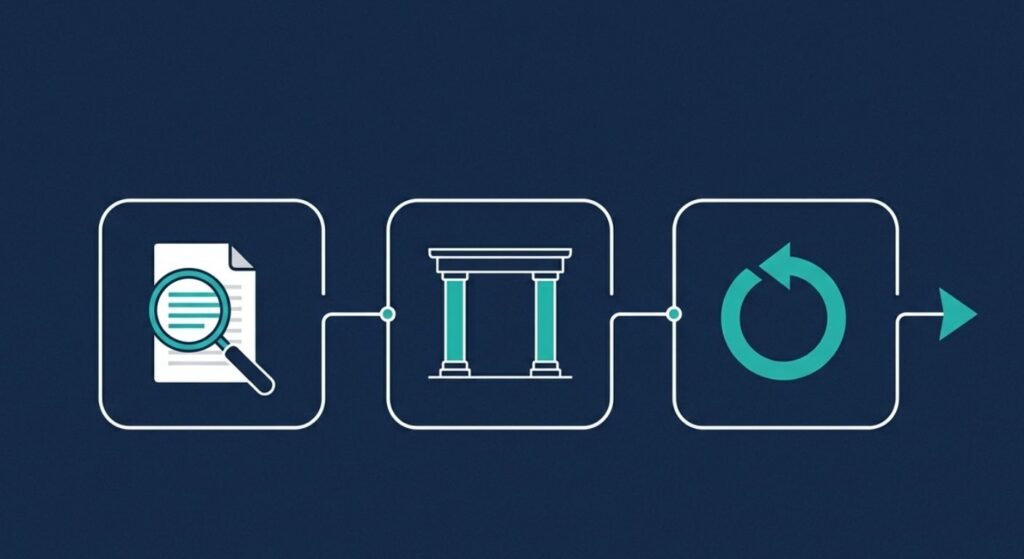
At Xemper, we treat accountability as a design constraint, not a policy that gets layered on afterwards. In practice, that comes down to three questions we ask of every agent we build, before it ever touches a real workflow.
1. Traceability: Can you show exactly what the agent used, and why?
An agent that produces a confident, fluent output is not the same as an agent that produces a trustworthy one. The difference is whether that output can be traced back to something concrete: a source document, a rule, a precedent, rather than to the model’s general sense of what sounds right.
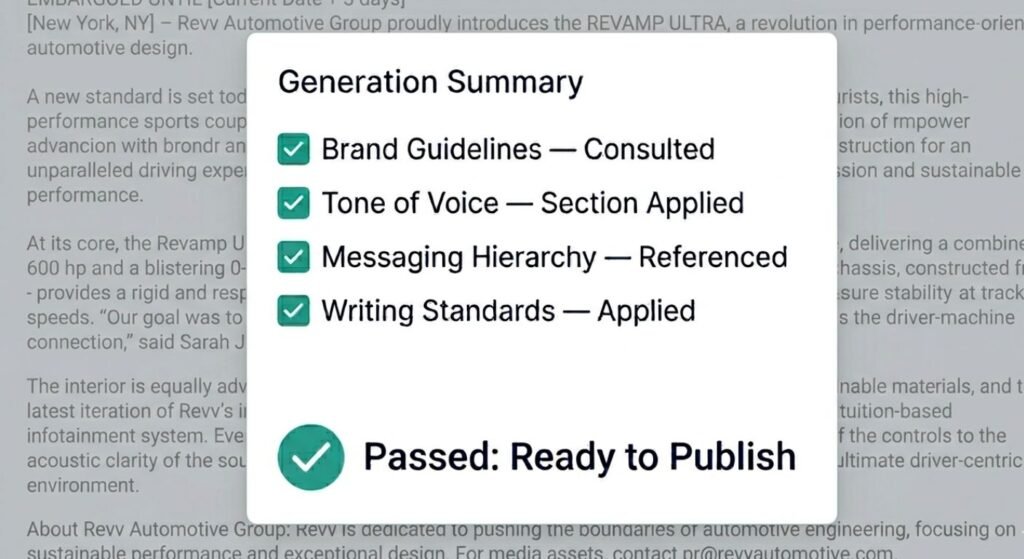
We build this in at the output level, not as an afterthought. Take a content-generation agent we built for a multi-brand organisation that needed press releases produced consistently across several distinct brand voices. The agent doesn’t just produce a draft; every generation comes with a transparency log, listing which brand documentation it consulted, which tone-of-voice section it applied, which messaging hierarchy it drew from, and why. Nothing in the output is generated from the model’s general knowledge alone; it’s assembled from the organisation’s own approved materials, and that lineage is visible.
The same principle applies on the review side. A companion agent we built to validate drafts doesn’t return a verdict like “this needs work.” It returns a structured report that cites the specific document and the specific principle a draft fails to meet. “Ready for distribution,” “minor edits needed,” or “needs revision” is never an opinion. It’s a conclusion the agent can show its working for.
Traceability is what turns an AI output from something you have to trust blindly into something you can actually check.
2. Boundaries: Does the agent know what it isn’t allowed to decide?
A capable agent isn’t one that always produces an answer. It’s one that knows the edge of its own competence and stops there.
In the agents we’ve described above, that boundary is explicit by design. If a brief is incomplete, the generation agent asks once for the missing detail. It doesn’t proceed on assumption, and it doesn’t quietly fill the gap with something plausible-sounding. Anything it genuinely cannot resolve is left as a clearly marked placeholder, handed back to a human rather than guessed at.
The review agent has an even stricter boundary: it is not permitted to rewrite or reposition the content it’s assessing. Its role is validation, not authorship. That separation is deliberate. An agent that both writes and approves its own work has no real boundary at all, just two passes of the same blind spot.
Designing boundaries well means deciding, before the agent is built, what it should never attempt on its own, and making that refusal a designed behaviour, not a failure mode.
3. Recourse: When the agent gets it wrong, is there a fast, clear way to catch it?
No agent gets it right every time, and a governance framework that assumes otherwise isn’t a governance framework. The real test is what happens next: how quickly an error surfaces, how clearly it’s flagged, and whether fixing it makes the system better or just patches the symptom.
This is part of why we typically build generation and review as two separate agents rather than one. A single agent checking its own work has limited ability to catch its own blind spots. Splitting the two means every draft passes through an independent, evidence-based check before it reaches a human, and that check is specific enough to act on immediately, because it’s tied to named documents and named principles rather than general impressions.
Recourse isn’t just about catching mistakes. It’s about making sure the correction loop is short enough, and clear enough, that people keep trusting the system rather than working around it.
Why this matters as agents take on more
None of this is difficult to justify when an agent is handling a single task at a small scale. The justification gets harder, and matters more, as agents start making a meaningful share of day-to-day decisions across an organisation. At that point, accountability isn’t a nice-to-have layered on top of capability. It’s the thing that determines whether an organisation can scale AI use with confidence or has to keep it permanently in pilot mode.
Governance, designed this way, isn’t friction on AI adoption. It’s the precondition for it. An agent that can show what it used, knows where its authority ends, and has a fast path for correction is an agent an organisation can actually scale, not just trial.
This is the standard we hold every agent we build to, before it ever goes near a real decision.
Ready to put this into practice?
If your organisation is deploying, or planning to deploy, AI agents into real workflows, the questions that matter most aren’t about which model to use. They’re about traceability, boundaries, and recourse, and whether those have been designed in from the start.
Xemper’s AI Consulting practice helps organisations work through exactly this: where agents should and shouldn’t be making decisions on your behalf, what governance needs to look like before you scale, and how to build the operating model that makes AI a dependable capability rather than a permanent pilot.
If you already have a clear use case in mind and want an agent built around your own workflows and documentation, our Tailored Agentic Solutions team can take it from concept to deployment.