
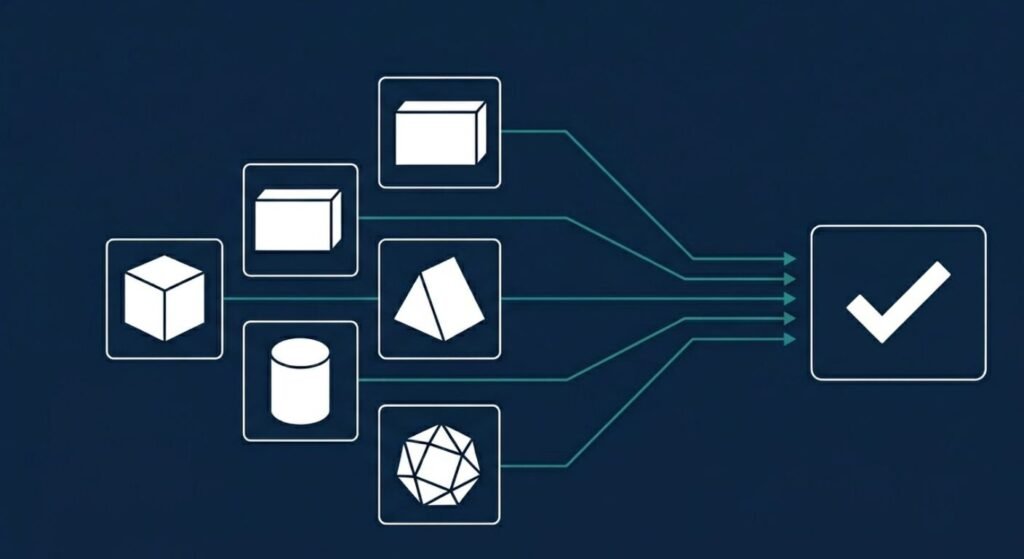
The simplest way to build an AI agent is to give one model the whole job, end to end. Draft the content, check the content, decide if it’s good enough, ship it. One agent, one context, one continuous line of reasoning from start to finish. It looks efficient on paper, and for a narrow enough task, it can even work.
It also has a structural flaw that doesn’t show up until the work matters: an agent that checks its own output is using the same reasoning to grade itself that it used to produce it. If its judgment was wrong in the first pass, that same judgment is what’s reviewing the result. The errors that slip through aren’t random. They’re the ones the agent was never going to catch, because catching them would have required a different kind of reasoning than the one that created them.
This is why, by default, we don’t build single agents that do everything. We build systems of agents, each with a narrower job and a different posture, working together. We think this is the right approach for any AI system doing work that matters, and it’s the principle we design around.
Separation of concerns
Different tasks need different constraints, and a single agent struggles to hold more than one posture well at the same time.
A drafting task benefits from latitude. It needs to generate, interpret a brief, make judgment calls about structure and phrasing, and produce something complete from an incomplete starting point. A validation task needs almost the opposite disposition. It needs to be narrow, sceptical, and rule-bound, checking a finished piece of work against a fixed standard without being persuaded by how polished it looks.
Asking one agent to be expansive and generative in one moment, then strict and critical the next, means it’s never fully either. The generative instinct that makes a good first draft is the same instinct that makes a self-review too forgiving. Splitting these into separate agents, each with its own scope and its own rules, means each one can actually be good at its specific job instead of being a compromise between two incompatible ones.
Independent verification
The real value of a second agent isn’t that it adds another check. It’s that the check is genuinely independent.
An agent reviewing its own output still has access to its own reasoning, even if you ask it to forget it. It tends to read its prior decisions charitably, because it already believes they were the right call; that’s why it made them. A separate agent, with no visibility into how the first agent arrived at its output, looking only at the finished result against the same fixed standard, doesn’t carry that bias in. It can flag something the original agent would have waved through, simply because it isn’t invested in the answer already being correct.
This is the same logic behind why audits aren’t conducted by the people being audited, and why code review isn’t done exclusively by the engineer who wrote the code. The reviewer’s value comes specifically from not having been part of the original decision.
Composability and control
There’s a practical engineering reason for this too, beyond accuracy. A system made of several narrow, well-defined agents is something you can actually maintain.
If a single monolithic agent starts producing weak results, the only lever available is to re-prompt the whole thing and hope the fix doesn’t disturb something else it was doing well. There’s no way to isolate the part that’s actually broken. A system of separate agents doesn’t have that problem. If the validation logic needs tightening, you adjust the reviewing agent without touching how drafts get generated. If the source material changes, you update what the generating agent can access without redesigning how review works. Each part can be audited, adjusted, or replaced on its own, because each part has a clearly bounded job.
This matters more as a system scales. A black box gets harder to trust the more it’s asked to do. A set of well-defined, independently inspectable parts gets easier to reason about, even as the overall system grows more capable.
This isn’t a new idea
None of this is unique to AI. It’s the same principle behind separation of duties in finance, where the person who approves a payment isn’t the person who initiated it. It’s the same principle behind editorial process, where a writer doesn’t sign off on their own copy before it runs. It’s the same principle behind software engineering, where the person who builds a feature isn’t the only person who decides it’s ready to ship.
What’s changed is that this principle now has to be designed into how agents are architected, not just how teams of people are organised. An AI system that skips this and relies on a single agent to write and approve its own work is recreating exactly the failure mode every one of those disciplines learned to design against.
How we apply this
This is the default posture we take when designing agentic systems: identify the distinct jobs inside a workflow, give each one its own agent with its own constraints, and make sure no agent is ever the sole judge of its own output. It takes more upfront design than building one large agent and hoping it holds every responsibility well. We think that upfront cost is what makes a system trustworthy enough to actually rely on at scale, rather than something that works in a demo and quietly degrades in production.
Ready to put this into practice?
If you’re evaluating an AI system, whether built in-house, by a vendor, or by us, it’s worth asking a simple question: is anything in this system checking its own work? If the answer is yes, that’s the first place we’d look before scaling it further.
Xemper’s AI Consulting practice helps organisations assess exactly this, whether the agentic systems they’re using or planning to build are architected with genuine independence between generation and judgment, or whether that separation only exists on paper.
If you have a workflow that needs an agentic system designed around these principles from the ground up, our Tailored Agentic Solutions team can take it from concept to deployment.